Networked Urbanism
design thinking initiatives for a better urban life
apps arid awareness bahrain bike bioclimatic climate culture Death design digital donations economy education energy extreme Extreme climate funerals georeference GSD Harvard hot interaction Krystelle mapping market middle east mobility Network networkedurbanism nurra placemaking Public public space resources Responsivedesign social Space time time management ucjc vallejo void waste Ziyi
Distributed Human Based Computation

Krystelle Denis | Ziyi Zhang

My network thus far (includes people and proposals).
The following are speculations on why people fear death and their body’s decay:
The Seventh Seal, Ingmar Bergman
Ingmar Bergman’s portrayal of death seems very classic, with his flowing black robes and intimidating features. The main character in the movie later states that he fears dying because he wants a guarantee that heaven awaits him.
The Hearse Song
Don’t you ever laugh as the hearse goes by,
For you may be the next one to die.
They wrap you up in a big white sheet
From your head down to your feet.
They put you in a big black box
And cover you up with dirt and rocks.
All goes well for about a week,
Then your coffin begins to leak.
The worms crawl in, the worms crawl out,
The worms play pinochle in your snout,
They eat your eyes, they eat your nose,
They eat the jelly between your toes.
A big green worm with rolling eyes
Crawls in your stomach and out your eyes.
Your stomach turns a slimy green,
And pus pours out like whipping cream.
You’ll spread it on a slice of bread,
And this is what you eat when you are dead.
This song was a popular “scary story” used to frighten friends at sleepovers. When my aunt explained that she wanted an airtight casket because the thought of worms eating her body terrified her, this is what came to mind. Through my conversations with people outside of the funeral industry I have found that many people do not understand the process of decomposition, especially the fact that it is inevitable. Many still operate under the misunderstanding that embalming preserves you for eternity, when, in fact, it merely used a highly toxic fluid to preserve your body for the short amount of time between your death and internment. Everything from your body to your “airtight casket” will eventually decay and return to the earth.


Assistant Director of the Sustainability and Environmental Management Program, Harvard Extension School
Aquaplot by Jenny Corlett + Kelly Murphy
A few independent groups in Massachusetts are trying to encourage a more positive acceptance of our mortality and how we think of and plan for death. Among them are the Green Burial Committee ( a sub-committee of the Funeral Consumer’s Alliance of Massachusetts) and Mourning Dove Studio. The documentary series Earthrise recently interviewed the two groups and their video, “Green Goodbyes,” takes us on a short tour of the limited green burial network in the state…

You can also check out my own interview with Ruth Faas in the post “Mourning Dove Studios” (coming soon).
Informative Landscape


Informative Landscape by networkedurbanism
Krystelle Denis | Ziyi Zhang

Cemeteries are at the center of a growing urban issue – with higher densities of the living we will inevitably face higher densities of the dead. However, while a number of designers and scientists have considered alternatives that either minimize the spatial requirements of human remains, suggest new dispersed, layered, digital or environmentally friendly typologies or combinations thereof, few have looked at the cemetery as part of a larger urban material ecology.

Thought provoking as the alternatives are, they can often inspire less thought and more provocation. The rituals of death are deeply ingrained and culturally significant, therefore, rethinking cemeteries requires designers to allow for traditional modes of mourning. Even if a significant portion of society were to accept the possibility that their bodies will be flash frozen and ground into a compostable powder, we already have a legacy of spatium mortus – land that is sacrosanct and untouchable (at least not without significant cultural and emotional backlash).

In response to this dilemma, I am proposing a layering of programs within cemetery grounds that goes beyond recreational use to turn cemeteries into productive spaces while maintaining respect for cultural norms. In simple terms a cemetery is a single-program urban space with specific material inputs, and no material output. However, that does not always have to be the case. By breaking down the underlying systems of cemeteries, the possibility of closing a material vector emerges.

Seeing as cemeteries are already organized into a field of plots with specialized and complicated maintenance regimes, the addition of a plant nursery is almost intuitive. While the growth of hardwoods necessary to close the container to container loop is a lengthy process, species with shorter growth schedules can be underplanted and either used within the cemetery or exported for profit. All the while the visitors and local ecosystem benefit from the well-studied beneficial effects of urban forests.
The film I will be presenting, Dive! Living Off America’s Waste, is actually about food waste in the US, as documented by an LA dumpster diver. The presentation slides below pull out the shocking statistics regarding the enormous waste of our food industry. The video relates to my larger research regarding the funeral industry in Massachusetts in that the narrator attempts to enact change at various points in the process from production to consumption to waste. My current efforts to map the network of postmortem processes in Massachusetts follows a similar logic – explore a variety of scales and points in the network to see where the most effective place for intervention is.
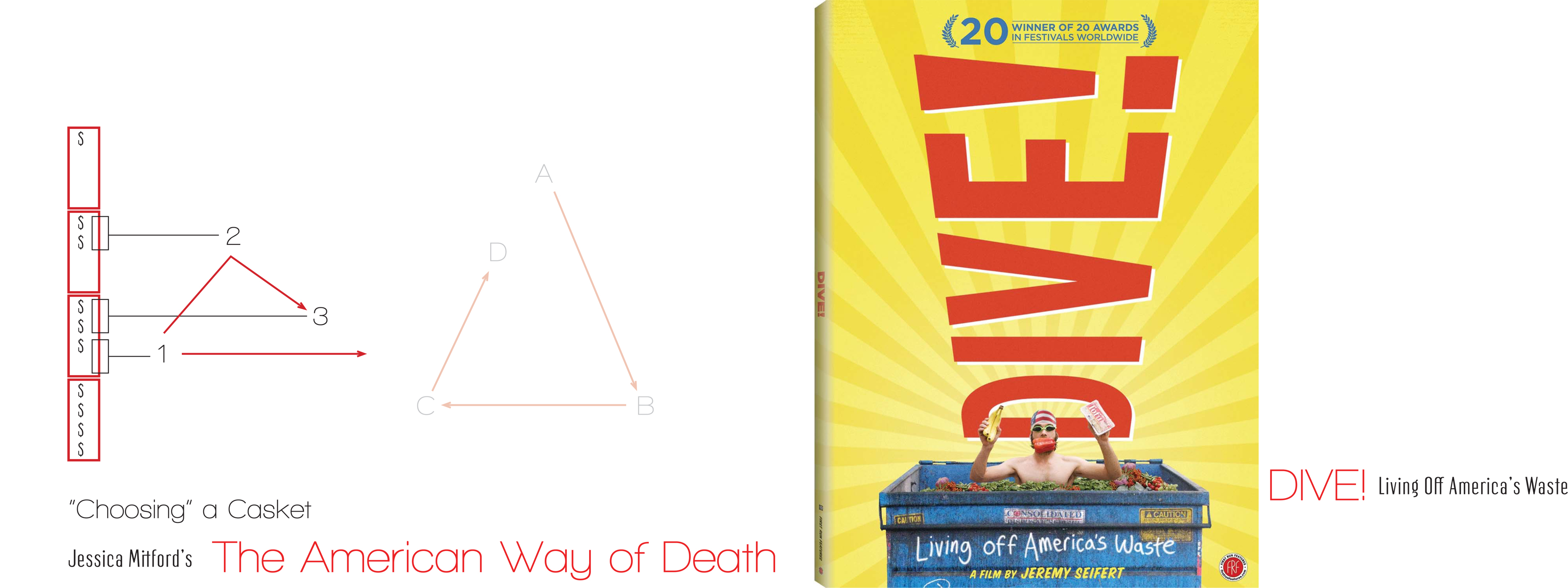
As a follow up I will present The American Way of Death, by Jessica Mitford. Written in 1963, this book is an expose of the inherent corruption in the funeral industry at that time. Many of the groups I am currently networking with, including the Funeral Consumer’s Alliance and Mourning Dove Studios, were established in reaction to Mitford’s research. She outlines with statistics, personal investigation and anecdotes the process by which funeral directors take advantage of grieving families to maximize profits. Mitford explains how funeral homes have formed monopolies against change by establishing relationships with casket manufacturers and cemeteries that guarantee the industry will work together to ensure their own financial success at the cost of the average consumer. Now consumer alliances have formed in many states to help people navigate the industry and protect their rights by providing information on burial laws and consumer friendly funeral homes. These organizations are currently leading the way towards more environmentally friendly burial options as well.
Dive! & The American Way of Death
E-CO
An augmented reality waste ecosystem.

Krystelle Denis | Ziyi Zhang
Scott Liang | Benjamin Scheerbarth
« Previous 1 … 22 23 24 25 26 … 38 Next »


